As a kid, I was more interested in reading maps than in actually visiting the places they represented. Now as an adult, I still enjoy identifying, labeling, and categorizing real world objects - but seeing those objects come to life in-person feels gratifying as well. My wife can attest to my excitement (and her bemusement at said excitement) when, on a trip to the San Francisco Bay Area, we drove through the western terminus of Interstate 80, a highway on which we had driven thousands of miles away in Ohio.
Street signs - like a physical version of a map label come to life, suspended above the objects they describe - scratch multiple itches for me, then. Just within my neck of the woods there are quite a few different designs with quite a few noticeable differences among them, so I wanted to document and share in case anyone else had the same nerdy interest.
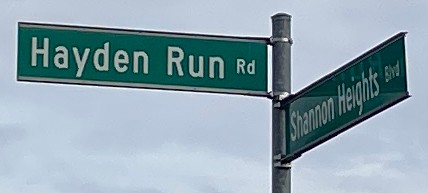
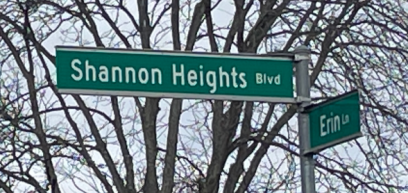
As "bog-standard" of a street sign as you can get - fitting the reputation of Columbus as a generic upper-middle-sized city. No alternate colors, no additional features. One nice aspect, at least of the newer Title Case signs, is that the sign width seems to match the text length pretty well. This avoids both highly condensed-looking text, and an awkwardly mostly empty sign.
However...
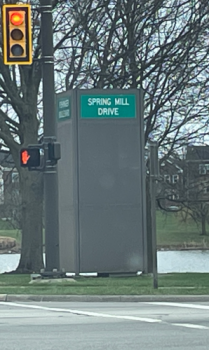
What the mother of crap is up with this thing? These godforsaken monstrosities show up along Fishinger Blvd, in the Mill Run strip mall/shopping center area. Maybe they were originally meant to list out the businesses on each road?
Overall score: 3 stars for mostly complying with the standard, well-done text
Mill Run giant rectangular solids: Minus 5 stars for being simultaneously hard to find when you need them, and grotesque when you do find them
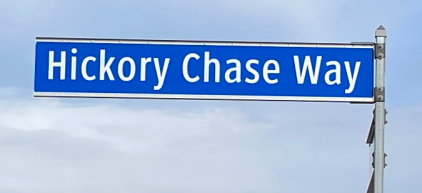
Signs attached to regular signposts seem to have decent spacing and font weight...but that's about where the consistency seems to end. Most examples above have the suffix printed with exactly the same size/weight/everything as the actual name - which isn't against the MUTCD (page 248 here), but just looks "off" in my opinion, especially since it doesn't line up with the adjacent jurisdictions of either Columbus or Franklin County.
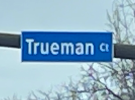
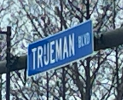
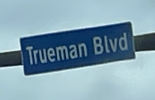
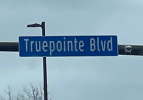
Overhead signs are all over the place - some have the Columbus-style text on the Hilliard blue, including the smaller suffix (both all-caps and Title Case), some match the signpost-mounted ones, and some look like the letters are too condensed, but the kerning is too wide. The Truepointe Blvd text looks simultaneously too spaced-out and too crowded.
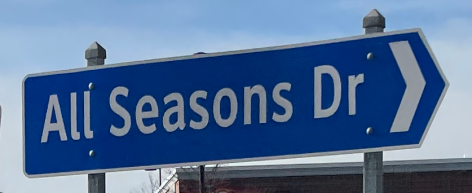
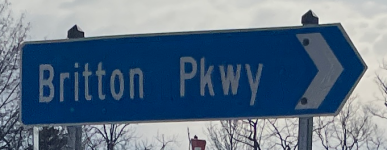
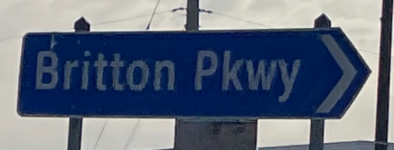
The three roundabout signs above are all from the same road - yet each one has a different chevron thickness, and the first Britton Pkwy sign has such an anemic font weight that it's actually a bit hard to read from the road.
Overall score: C-, with minor credit for following along with the city's blue color scheme, but deductions for exploring the number of different fonts that can be created from what's presumably the same base typeface
For further reading: the Manual on Uniform Traffic Control Devices for Streets and Highways, Section 2D.45 - Street Name Signs (D3-1 and D3-1a)